Saturday, February 21, 2015

Motorola Moto Maxx (Global Variant of Droid Turbo) coming to India, exclusively on Flipkart

Flipkart, one of India's biggest online stores has just released an interesting teaser on Twitter. It has to do with a new Motorola device that the retailer simply refers to as a "Moto beast". Now this could refer to a lot of smartphones, but thankfully the included banner clears the smoke and almost definitely point in a single direction.
It reads "Accelerated performance. Ballistic Nylon Fairing. Revving in soon." Whole this sounds like a lot of gibberish to ramp up the hype it most likely describes the Motorola Moto Maxx. The phone is essentially a global variant of the Droid Turbo and comes with a unique back panel, dubbed "Ballistic Nylon" so Flipkart is most certainly talking about the Maxx.
The Moto Maxx comes equipped with a formidable Snapdragon 805 SoC with four Krait 450 cores, clocked at 2.7GHz. The GPU is an equally impressive Adreno 420 and the setup is backed up by 3GB of RAM and 64GB of onboard storage. Cameras also do not disappoint. Motorola has invested heftily in the primary shooter, which is a 21 MP, f/2.0, dual-LED model, capable of 2160p video at 24fps.
Another important aspect of the phone is its extremely spacious 3,900 mAh battery pack, ensuring maximum endurance. And if this is not tantalizing enough, Motorola also promises that its own turbo charger can restore up to 8 hours of battery life in the phone for a mere 15 minutes of charging.
There is still no word on pricing for the device or when it is going to be up for sale, but it looks like it will be hitting Flipkart really soon. So if you are in the market for a high-end device, be sure to check out the Moto Maxx in all its "turbocharged" glory.

Monday, January 26, 2015

Samsung will manufacture the Tizen-based Z1 in India

Samsung will manufacture the Tizen-based Z1 smartphone in India. The Korean giant launched the affordable device in the country earlier this month.


The device’s manufacturing process will take place in Samsung’s Noida facility in India. The company’s Vice President of Marketing for India confirmed the news.
Targeted a first-time smartphone buyers, the dual-SIM Samsung Z1 is priced at Rs 5,700 (about $93). According to industry sources, the Korean giant has sold about 50,000-55,000 units of the handset since its launch in mid-January. This is a stellar achievement for the Tizen device considering the highly competitive price segment it inhabits.
Samsung will soon launch the Z1 in Bangladesh. The device is not likely to make it to more mature global markets.

Cyanogen looking to break dependence from Google

At an event in San Francisco, the CEO of Cyanogen Inc. Kirt McMaster spoke about the company's bold plans about the future. As it turns out, Cyanogen has ambitions “to take Android away from Google.”


Cyanogen wants to provide an open version of Android on a deeper level than what’s currently available. This will allow the company to offer its partners “tier one services.”
McMaster gave Google Now as an example. The search giant’s mighty personal assistant interacts with the core of Android in a way third-party apps are not allowed to. Cyanogen plans to give such access to apps made by their partners. One example discussed was Yahoo’s Aviate launcher, which could benefit from such deep integration into the OS. of course, for that to become a reality, Yahoo would have to team up with Cyanogen, so for now that remains only an example.
Furthermore, Cyanogen plans to “not be based on some derivative of Google in three to five years.” This means that the company plans to break away from Google Play services. The latter are unsurprisingly firmly controlled by the search giant.
Cyanogen plans to break away from Google Play services by creating its own app store in collaboration with partners. The latter is expected to go live within 18 months.
Overall, it appears that Cyanogen has more or less had it with Google and its control over Android. We are quite curious to find out if the small, yet ambitious company can materialize its bold plans. So far, only Amazon has somewhat managed to do so, though, it is worth noting, that the retail giant has considerably more resources than Cyanogen.

Saturday, December 27, 2014

Samsung Z1 leaks in live photos, launch date confirmed

The Samsung Z1 Tizen-based smartphone leaked almost a week ago with details regarding the phone's availability and specs. A new set of live photos of the phone showed up today however, further giving us reason to believe Samsung won't back out of the Z1's release.


The phone is a typical low-end budget device with a 4" display of 800x480 pixel resolution and a still unspecified dual-core 1.2GHz CPU with 768MB RAM. Internal storage is 4GB, expandable via the on-board microSD card slot and under the back cover lies a 1,500mAh batter.


The Z1 will have dual-SIM card slots and feature 3G, Wi-Fi b/g/n, Bluetooth 4.0, GPS and FM radio. Samsung has equipped it with two modest cameras - a 3MP at the back with LED flash and a 0.3MP at the front.


The company aims at January 18 for the phone's launch with India being the first country to welcome the device. Later, the Samsung Z1 will arrive in China and South Korea. Pricing is likely to be under $90.

Kodak will unveil a range of Android devices at CES

Kodak will unveil a range of mobile devices with Android OS. The first smartphone from the new product family will be unveiled in less than two weeks, during CES in Las Vegas.


Kodak’s family of smartphones and tablets will be aimed at customers looking for high-end, yet simple user experience. There is no word on specs just yet - all we know is that the devices “will come pre-loaded with bespoke image capture, management and sharing features to offer a rich user experience.”

Saturday, September 27, 2014

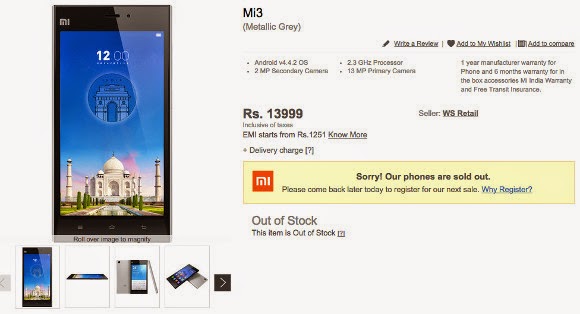
Xiaomi Mi 3 to make a return to India

The Xiaomi Mi 3 was a runaway success during its short stay in India earlier this year. The smartphone batches were selling out in seconds with thousands of people never managing to get the unit they wanted. That's why when the company announced that it will be stopping the sales of the former flagship and replacing it with the Redmi 1S it caused quite a lot of discontent.
There's a silver lining to this cloud though - Xiaomi has reevaluated its decision and decided to bring the Mi 3 back to India. During an event in Bengaluru, a Xiaomi spokesperson confirmed that the smartphone will be back in stock in time for the Diwali festival (Thursday, October 23).


There were no specifics mentioned about the pricing and availability channels, but there will likely be no changes there. This means that Xiaomi will probably stick to Flipkart as its partner and sell the Mi 3 for INR 13,999 (roughly $230). We are just hoping the Chinese manufacturer brings enough units this time so they last for more than a few seconds.

Alleged Motorola Nexus 6 appears in a live photo next to the LG G3

The Motorola Shamu, believed to be the upcoming Nexus 6 smarptohne, is starring in a live photo with the LG G3. The phone looks substantially larger than the G3, which carries a 5.5" display. This lends further credence to rumors that the Shamu is going to feature a display in the 6" ballpark.


The photo clearly shows that the Shamu features a soft-touch plastic back and keeps the metal frame from the Moto X (2014). This is clearly an indication that Google likes to keep the soft touch back that made a debut on the Nexus 5 and the Nexus 7 (2014).
In terms of specifications, the rumor mill suggests the Nexus 6 by Motorola is going to feature a Qualcomm Snapdragon 805 SoC, 3GB of RAM, 32GB of built-in memory. The screen is said to have a 5.92" diagonal and QHD resolution for a pixel density of 498ppi. At the back, the camera is reported to have a 13MP sensor, LED flash and 4K video recording skills.
The battery of the Shamu is allegedly a 3,200mAh unit. As with all recent Nexus smartphones, don't expect a microSD card slot. The Shamu should be unveiled at Google's Android L release event and will run it out of the box.

Google tipped to require more of its apps on Android devices

According to a report in The Information, Google will require more of its apps to be preloaded on Android devices. Confidential contracts obtained by the media have revealed the upcoming change.


Allegedly, Google will require up to 20 of its apps preloaded going forward. Currently, the number hovers below 10.
Additionally, the search giant will require the apps to be prominently displayed on a device’s homescreen. The list of manufacturers in Google’s contracts includes the likes of Samsung, HTC, and Huawei among others.
The shift in Google’s policy towards its own Android apps is reportedly related to the ever-increasing importance of the OS as an income generator. Google’s apps and services have become a key contributor to its bottom line.

Thursday, September 11, 2014

Snapdragon 210 with quad-core CPU and LTE goes official

Today Qualcomm announced its next generation affordable chipset - Snapdragon 210. Its key upgrades over the existing Snapdragon 200 include better Adreno 304 GPU, 1080p video capture and playback support, and LTE Cat.4 connectivity.


These are the new Snapdragon 210 key specifications:
  • Quad-core ARM Cortex-A7 processor up to 1.1 GHz
  • Adreno 304 GPU with support of 720p displays
  • 8MP camera support
  • 1080p video recording and playback
  • LTE Cat.4 connectivity
  • LTE dual-SIM support
  • Quick Charge 2.0 support (up to 75% faster charging)
Qualcomm expects the new entry-level Snapdragon 210 chipset to become available in various affordable smartphones in the first half of 2015. The manufacturer hopes its latest design will enable the creation of the first LTE-A sub-$100 smartphones.

Android in August: KitKat runs on a quarter of all devices

Google released its Android distribution report for the month of August. Unsurprisingly, Android 4.4 KitKat continues its march towards larger market share – it now runs on almost a quarter of all devices out there (24.5% to be precise).


The gain of Android 4.4 came mostly at the expense of Android 4.1 Jelly Bean and Android 4.0 Ice Cream Sandwich. Both builds lost some of their share over the month of August.
Android 4.2 and Android 4.3 Jelly Bean registered a slight gain in share. Android 2.3 Gingerbread dropped to 11.4%, while Android 2.2 Froyo remains on 0.7% of all devices.
We don’t expect any dramatic changes to the overall landscape in September – Android 4.4 will certainly continue its march towards larger cut of the distribution pie. The impending launch of Android L will surely alter things in the months beyond.